A procedural fairness letter Canada file is not a refusal — but the deadline is real. IRCC (or another decision-maker) is telling you there is a concern that can sink the application unless you answer it with evidence.
Quick answer: Meet the stated deadline, answer the exact allegation, include a labelled evidence index, and avoid generic explanations. If the letter alleges misrepresentation, inadmissibility, criminality, relationship genuineness, or medical issues, call 905-744-8888 or email info@ullaw.ca before you file. You can also book a free consultation.
In Canadian administrative law, this is the point where the decision-maker must tell you what is wrong and give you a chance to answer before refusing on that basis.
Receiving That Unexpected Letter
A typical client opens the letter, reads the first paragraph twice, and fixates on one phrase such as “misrepresentation,” “inadmissibility,” or “concerns regarding credibility.” That reaction is understandable. These letters are written in legal and administrative language, not plain English.

What matters first is this. A procedural fairness letter is not the refusal itself. It is notice that an officer believes there may be a problem serious enough to justify refusing your application unless you answer it properly.
Why the letter feels worse than it is
The letter often lands after a long wait. If you’ve already been tracking Canadian immigration processing times, the sudden shift from silence to scrutiny can feel like your case has collapsed. In practice, this stage is often the first real chance to correct the record, explain context, or provide evidence the officer believes is missing.
Clients often make one of two mistakes in the first day:
- They freeze: they do nothing because the letter sounds final.
- They rush: they send a quick explanation without understanding what the officer is alleging.
Neither response helps.
Practical rule: Treat the letter as a live legal problem, not as a personal attack and not as a formality.
What to do in the first 24 hours
Start with a calm file review. Save the letter, download any attachments, and compare the allegations to what was originally filed. If someone else prepared the application, get a full copy of the submission immediately.
Then ask three basic questions:
- What exactly is the officer concerned about
- What documents or explanations could answer that concern
- What deadline controls the response
Those three questions shape everything that follows. A strong response is rarely emotional. It is organised, targeted, and supported by evidence.
What Is a Procedural Fairness Letter?
A Procedural Fairness Letter, often called a PFL, is formal written notice from a Canadian decision-maker that there is a concern which may lead to a negative decision unless you respond. In immigration matters, that decision-maker is often IRCC. In other administrative contexts, a different public body or tribunal may play that role.

The legal idea behind it
Canadian administrative law requires fairness in decision-making. In the immigration context, that duty includes three core protections. As explained by Sultan Lawyers on procedural fairness in Canadian immigration, an applicant has the right to know the case against them, the right to respond, and the right to an unbiased decision-maker.
That sounds abstract until you apply it to a real file. If an officer intends to rely on a concern that could sink your application, you must be told what that concern is and given a chance to answer it.
Why this matters in practice
A PFL is the mechanism that puts those rights into motion. It tells you what the officer thinks is wrong. It also creates a record showing whether you were given a fair opportunity to respond.
That has two immediate consequences:
- For the applicant: the response becomes a decisive part of the file.
- For the officer: they can’t fairly refuse on undisclosed concerns and expect that decision to be insulated from challenge.
If the officer never gave you a proper chance to answer a concern that affected the refusal, the fairness issue may become central to a Federal Court challenge.
What a PFL is not
It isn’t a routine request for missing paperwork. It usually signals a deeper concern about credibility, admissibility, eligibility, or accuracy. It also isn’t something to answer with generic reassurance. The whole point is to deal with the identified issue directly.
A useful analogy is this. A PFL is not the verdict. It is the court telling you what argument the other side is about to rely on, and giving you one real chance to answer before the decision is made.
Common Reasons for Receiving a PFL in Canada
Procedural fairness letters usually arise when the decision-maker sees a mismatch between what the application says and what the evidence appears to show. In immigration files, certain patterns come up again and again.
Immigration concerns that trigger PFLs
The most frequently cited immigration reasons include criminal inadmissibility, genuineness of relationship concerns, misrepresentation allegations, and Express Entry issues such as incorrect NOC codes or insufficient employment evidence, as outlined by Can X Global’s discussion of common PFL triggers.
Here is how those concerns often appear on real files:
- Criminal inadmissibility: The issue may involve the applicant, or sometimes a family member whose history affects the overall application.
- Relationship genuineness: Officers look for inconsistencies, weak documentation, or facts that make the marriage or partnership appear non-genuine.
- Misrepresentation: This can involve false information, omitted facts, or questionable documents.
- Express Entry employment problems: Job duties may not align with the selected NOC, or the work evidence may be too thin to support the claimed experience.
- Provincial nomination residence intention issues: An officer may question whether the applicant intends to reside in the nominating province.
One common example is the family sponsorship file where the forms are technically complete, but the timeline of the relationship doesn’t line up cleanly with travel records, prior addresses, or earlier applications. In those cases, the officer is often testing credibility, not merely requesting more photos.
If your issue is tied to a spousal or family file, it can help to understand the refusal logic that often develops in these cases. UL Lawyers has a practical resource on sponsorship refusals in Canada.
What tends not to work
The same source also notes that generic explanations and document dumping frequently result in refusals. That matches what practitioners see regularly. Sending hundreds of pages without a theory of the case doesn’t solve an officer’s concern. It often confirms that the applicant has not answered the allegation.
A good response doesn’t ask the officer to find your argument somewhere in the attachments. It states the argument clearly and then proves it.
Where disability and employment issues intersect
Many applicants are often caught off guard. A PFL that starts as an immigration problem can spill into other parts of life in Ontario.
A medical inadmissibility concern may overlap with a CPP disability application, a long-term disability file, or an employment accommodation issue. Statements made in one forum can affect credibility in another. For example, if an applicant tells IRCC one thing about functional limits and tells an insurer or employer something materially different, that inconsistency can create problems beyond immigration.
The same is true for employment evidence. An Express Entry PFL about job duties can expose weaknesses in employer letters, payroll records, or termination circumstances. If there is also an employment dispute, those facts need to be handled carefully and consistently.
How to Interpret Your Procedural Fairness Letter
The letter itself usually tells you exactly how to build the response, but only if you read it carefully. Most weak replies come from people answering what they think the issue is, instead of what the officer wrote.

Start with the deadline
The response window for a PFL typically ranges from 7 to 30 days, and after submission the officer’s review can take anywhere from 30 days to over one year, according to this discussion of PFL timing in Canada. That means two things. First, the response period is short. Second, the submission may shape the file for a long time afterward.
Read the due date first. Then confirm the submission method, time zone, and whether the officer has requested specific formats or supporting materials.
Break the letter into parts
Use this checklist as you review it:
| Part of the letter | What to look for |
|---|---|
| Legal concern | Is the issue credibility, admissibility, eligibility, or misrepresentation |
| Factual allegation | Which statement, form answer, or document is being questioned |
| Requested response | Does the officer want explanation, documents, or both |
| Deadline | Exact final date and any instructions for delivery |
| Consequences | What negative decision may follow if the concern is not answered |
Once you identify those parts, compare them to the application package and your records. Don’t rely on memory. Use forms, prior refusals, employer letters, tax records, medical reports, travel history, and any previous immigration filings.
Look for what is missing from the letter
Sometimes the officer’s concern is clear. Sometimes it is broad and frustratingly vague. If the reasoning is hard to follow, that can affect later strategy, including whether there may be a basis for judicial review of an immigration decision in Canada.
Read the letter like evidence, not correspondence. Every sentence tells you what the officer may rely on later.
The practical task is to identify the actual dispute. Is the officer saying the document is false, the explanation is incomplete, the facts don’t line up, or the law makes the applicant inadmissible even if the facts are true? Each of those requires a different style of response.
2026 Procedural Fairness Letter Response Checklist
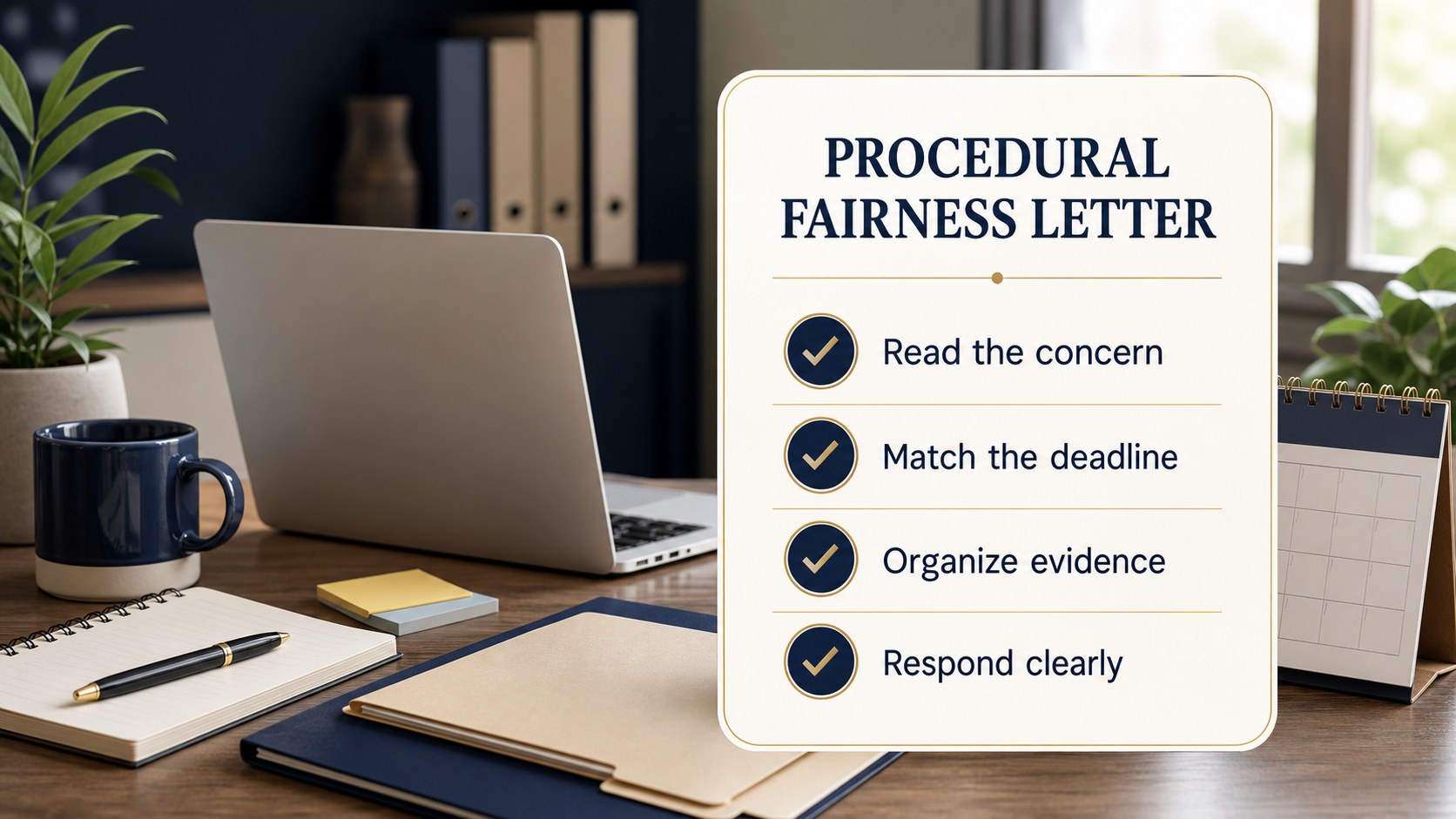
Use the letter itself as the roadmap. A strong response is not a general character letter or a pile of attachments. It is a point-by-point answer to the concern that was actually raised.
First 24 hours
- Save the complete letter and attachments: keep the original PDF, email, portal notice and envelope if relevant.
- Calendar the deadline and time zone: do not assume “30 days” means the same thing in every portal or office context.
- Download the full application package: forms, representative submissions, upload receipts, prior refusals, GCKey messages and supporting documents.
- Identify the allegation type: credibility, misrepresentation, inadmissibility, eligibility, relationship genuineness, employment history, financial capacity, medical concern or missing evidence.
- Do not send a quick emotional reply: a rushed explanation can create new inconsistencies.
Evidence to organize
| Concern in the PFL | Useful evidence to consider |
|---|---|
| Misrepresentation or inaccurate forms | corrected chronology, explanation of the mistake, prior forms, emails with representatives, supporting records |
| Employment or NOC concerns | employer letters, contracts, pay records, tax slips, job descriptions, organizational charts, sworn statements |
| Relationship genuineness | timeline, communication records, travel records, financial proof, photos with context, family/community evidence |
| Financial capacity | bank records, source-of-funds explanation, employment income, tuition/payment proof, sponsor records |
| Medical or disability issues | updated medical reports, treatment plans, functional evidence, mitigation plan, consistency with disability or employment records |
What the response should include
- A short opening summary identifying the letter, application and concern.
- Issue-by-issue headings that mirror the officer’s allegations.
- A clear factual explanation that admits mistakes where necessary and corrects the record with evidence.
- A labelled evidence index so the officer can find each document quickly.
- A focused closing submission explaining why the concern should be resolved and why refusal would not be justified on the updated record.
IRCC warns that false documents or information can lead to refusal, a fraud record, removal consequences and a ban from Canada for at least five years. That is why a misrepresentation PFL should be answered carefully, honestly and with documents that match the explanation.
Crafting an Effective PFL Response Strategy
A persuasive response is built, not improvised. The officer has already identified a concern serious enough to justify refusal. Your job is to answer that concern directly, with organised evidence and a coherent explanation.
What an effective response includes
Start with a written roadmap. The response should track the letter point by point so the officer can see that nothing was ignored.
A useful structure often looks like this:
-
Opening summary
Identify the application, the date of the PFL, and the concern being answered. -
Issue-by-issue response
Take each allegation separately. Quote or paraphrase the concern accurately, then answer it with facts and documents. -
Supporting evidence index
Label attachments clearly. If there are affidavits, employment records, medical reports, or corrected forms, identify them precisely. -
Closing submission
State why the concern has been resolved, or why the legal conclusion suggested in the PFL should not follow from the facts.
What works and what doesn’t
The difference is often simple.
What works
- Direct admissions where needed: If there was an honest mistake, explain it cleanly and fix it with evidence.
- Relevant records: Updated employer letters, tax documents, police records, specialist reports, travel records, or sworn statements can all matter if they answer the actual concern.
- Consistent chronology: A timeline often helps when dates, travel, relationships, or job histories are in dispute.
What doesn’t
- Emotional arguments: Anger at the system doesn’t resolve the allegation.
- Overproduction without analysis: A large stack of papers is not a legal answer.
- New inconsistencies: Last-minute explanations that conflict with earlier filings can make things worse.
The source material in the earlier section already noted that generic explanations and document dumping tend to fail. In practice, this is one of the most important strategic points in PFL work.
Misrepresentation changes the risk level
If the letter raises misrepresentation, the file must be treated with extreme care. As explained by Kingwell Immigration Law on PFL misrepresentation consequences, a finding of misrepresentation, including false or misleading information provided even unintentionally, can lead to refusal and a bar from entering Canada for up to five years.
That risk affects how you respond. You cannot bluff your way through a misrepresentation allegation. You need a precise account of what happened, why it happened, and what reliable evidence supports your explanation.
Key point: If there is an error in the file, correcting it honestly is usually safer than defending the indefensible.
A practical file-building approach
For many applicants, the response also has to account for other legal problems unfolding at the same time. A worker may be trying to restore status after a permit issue, defend an employment record, and answer IRCC on the same facts. If your temporary status is part of the picture, review the legal framework for restoration of status in Canada before you make assumptions about what can or can’t be fixed.
Use a simple evidence protocol:
- Create one master timeline: dates of applications, work, travel, marriage, studies, treatment, or charges.
- Match each document to one issue: every attachment should answer a specific concern.
- Check consistency across forums: immigration, Service Canada, insurers, employers, and prior applications should not tell conflicting stories without explanation.
- Review before filing: names, dates, translations, signatures, and references should align.
A good response doesn’t try to say everything. It says what is necessary, proves it, and leaves the officer with a clean path to accept your explanation.
When You Need a Lawyer for Your PFL Response
Some PFLs can be handled without counsel. Others carry too much legal and factual risk to approach casually. The line usually becomes clear when the allegation involves credibility, inadmissibility, or consequences that extend beyond the immigration file itself.

Red flags that justify legal help
You should strongly consider legal representation if the letter involves:
- Misrepresentation allegations: the wording may seem narrow, but the consequences are severe.
- Criminality or medical inadmissibility: these files often require legal analysis plus supporting records from outside the immigration system.
- Relationship genuineness concerns: these cases are evidence-heavy and highly sensitive to inconsistency.
- Employment history disputes: especially where NOC alignment, payroll records, or employer cooperation are already weak.
- Cross-over disability issues: medical information may affect immigration, CPP disability, LTD benefits, and work accommodation at the same time.
Why multidisciplinary coordination matters in Ontario
Medical, employment and disability-related PFLs can create problems beyond the immigration file. IRCC may ask about medical information, work history, job duties, income, school records or family circumstances that also appear in CPP disability, long-term disability, employment accommodation, human rights, WSIB or insurance records. If the same facts are described differently in different systems, credibility can become the problem.
That is why the response should be coordinated before it is filed. A medical letter should not contradict disability-benefit records. An employment-history explanation should match tax slips, payroll records and employer letters. A relationship timeline should match travel records and prior applications. The goal is not to over-explain every side issue; it is to make sure the evidence tells one accurate story.
If the facts in your immigration file also appear in your disability claim, LTD claim, employment dispute or benefit application, review them together before anything is sent.
The decision is strategic, not personal
Hiring a lawyer doesn’t mean you did something wrong. It means you recognise that the response may decide more than one legal problem at once. In many PFL files, the challenge isn’t just proving one fact. It’s protecting the client from avoidable contradictions across several systems that all use the same records.
Frequently Asked Questions About Procedural Fairness Letters
| Question | Answer |
|---|---|
| Does a procedural fairness letter mean I’ve been refused? | No. It means the decision-maker has concerns and is giving you a chance to answer them before a final decision. |
| How much time do I have to reply? | The deadline is set out in the letter. Read it immediately and follow the submission instructions exactly. |
| Can I ask for more time? | Sometimes, yes. Any request should be made promptly and supported by a clear reason, especially if you need records that can’t be obtained immediately. |
| Should I answer every issue listed in the letter? | Yes. A partial response often leaves the strongest allegation unanswered, which can invite refusal. |
| What if I made a mistake in my application? | Correct it honestly and support the explanation with documents. Trying to hide an error usually creates a larger credibility problem. |
| What should a procedural fairness letter response include? | It should include a short summary, point-by-point answers to each concern, a labelled evidence index, corrected information where needed, and a focused explanation of why the concern has been resolved. |
| What if the PFL alleges misrepresentation? | Treat it as high risk. IRCC warns that false documents or information can lead to refusal and a ban from Canada for at least five years. Get advice before filing a response that could affect future applications. |
| What happens after I submit the response? | The officer reviews the materials and then decides whether the concern has been resolved. The review period can be lengthy, so keep copies of everything submitted. |
| What if the application is refused anyway? | The next step depends on the reason for refusal and the process used. In some cases, a Federal Court challenge may be available. |
| When should I get legal advice? | Early. That is especially true if the letter raises misrepresentation, criminality, medical inadmissibility, relationship genuineness, or overlapping disability and employment issues. |
If you’ve received a procedural fairness letter, call 905-744-8888 or email info@ullaw.ca before the deadline. UL Lawyers acts for clients across Burlington, the GTA, and Ontario. You can also book a free consultation.